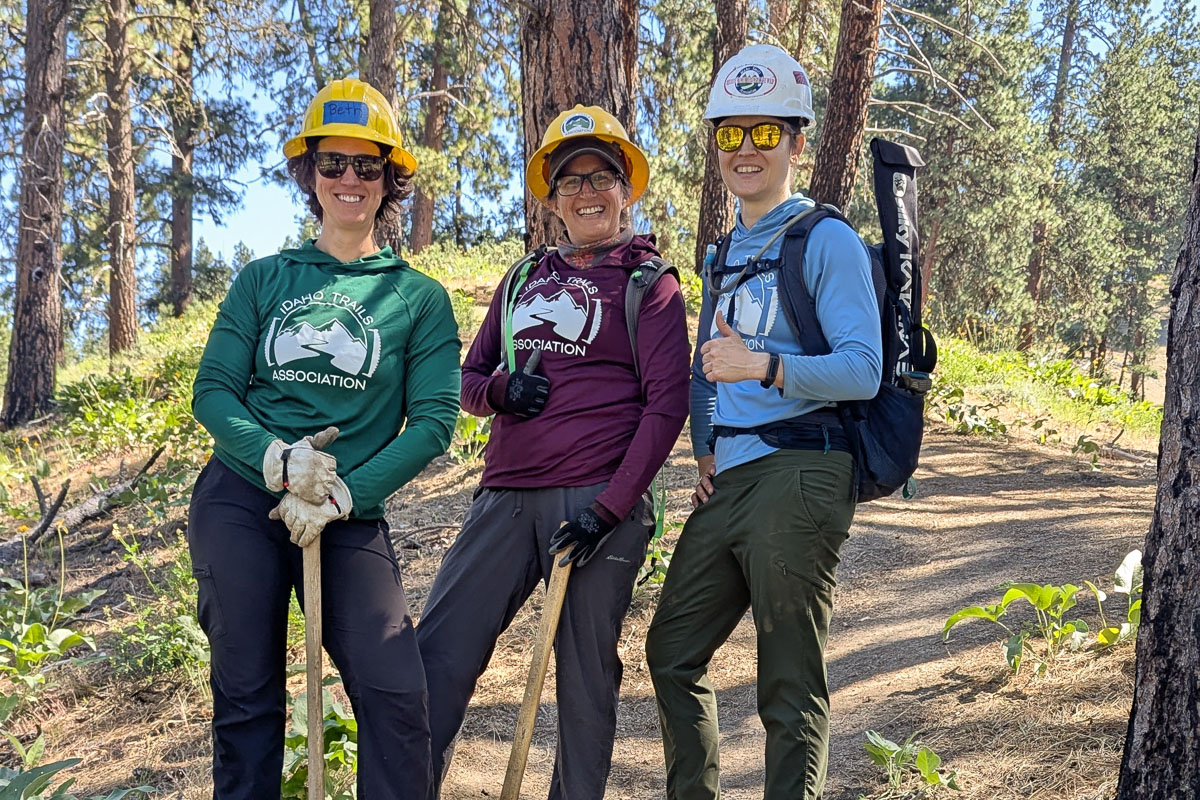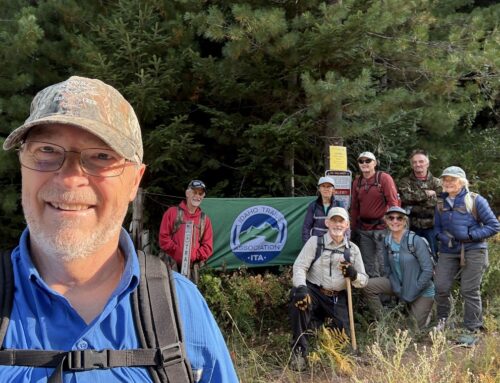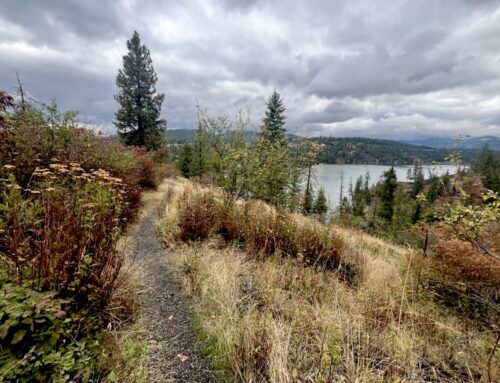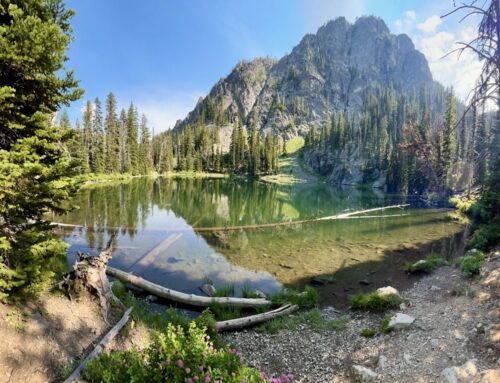
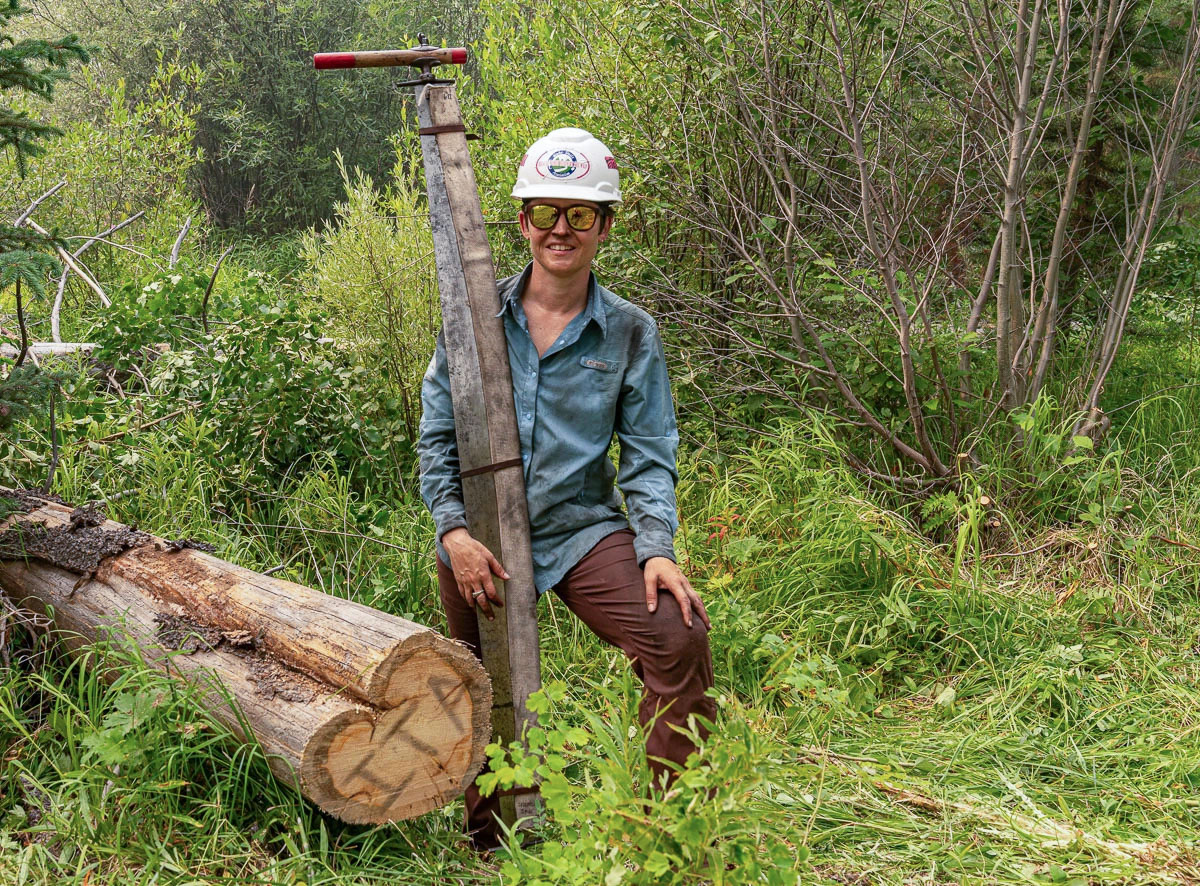
We are so grateful to ITA Board Member and Crew Leader Pam Bond for 10 years of service with ITA! Her first ITA project was Perjue Canyon in 2016 and since then she has been a rockstar volunteer for ITA, helping us with GIS mapping projects, building and maintaining our Trail Reporter, serving on our Board of Directors, recruiting volunteers and supporters through the Trail Master Presentation series, starting our Women in the Wild Program, and co-leading our first Wilderness Immersion Project. ITA wouldn’t be what is today without you, Pam! Thank you for all you do for trails.
What is your background in? What are some of the things you enjoy doing for fun?
I grew up wanting nothing more than to take care of animals. I was the kid who adopted every stray and always had a pet of some kind. During my undergraduate years, I interned at a veterinary hospital and quickly realized I didn’t quite have the stomach for the sights and smells of a medical facility.
My stepmom later gave me a book about wildlife rehabilitation, and I thought I had finally found my calling. I interned at two wildlife rehab facilities and absolutely loved the work, but full-time opportunities were few and far between, especially in the West. After a bit of floundering, I ended up working for Idaho Fish and Game as a wildlife technician in McCall. I really enjoyed that job and learned a lot—including how to use GIS for mapping and data analysis.
During the 2008 recession, I was told that the funding helping to support my position might be cut, with no guarantees about future work. I had already been considering graduate school, so I decided to go back and ultimately ended up at Idaho State University’s Boise Center Aerospace Lab studying GIS and remote sensing and obtained a M.S. in Geographic Information Sciences.
After about a decade working as a GIS analyst for state and local government, I started my own consulting business, Go West Geospatial Services. I’ve been fortunate to pick up work largely through my professional network, which still leaves me some time to do pro bono GIS work for nonprofit organizations like ITA.
Outside of work, I love to hike, backpack, climb mountains, explore canyons, go to the movies, see live music, poorly play the mountain dulcimer, and spend quality time with my friends and family. My favorite vacations involve hiking – section hiking the PCT has been amazing and last year I spent 6 days in the Italian Dolomites hiking hut to hut. Spectacular mountains!
How and why did you first get involved with ITA? What are the different ways you’ve volunteered for ITA over the years?
Funny enough, it all started because of the Pacific Crest Trail. In 2015, I began section hiking the PCT and frequently encountered trail crews during those first couple of years. One day my hiking partner and I came across a volunteer with the Trail Gorillas—who work on the PCT in Southern California—taking a break. We started asking him questions about the work they were doing. Long story short, I told him I’d gather some intel for him. As we hiked along the trail, we stopped at every downed tree, collected a waypoint, took photos, and estimated the diameter. Whenever I got into cell range, I would send him the information. A couple of weeks later we ran into the same volunteer again—this time with a group of other volunteers—and they actually cheered when they saw us. The information we had been sending was incredibly helpful because it allowed them to prioritize where to focus their efforts and what sizes of saws they would need. I was hooked. It felt great to give back to the trail.
When I returned home, I immediately reached out to both ITA and the Selway Bitterroot Frank Church Foundation. I still remember sitting on the patio at Whole Foods talking with Jeff Halligan about how to get involved. At the time, I thought maybe I’d create a few maps here and there or volunteer on the occasional project. I had no idea ITA would eventually become such a big part of my life.
My first ITA project was in Perjue Canyon in June 2016. This year marks 10 years of involvement with the organization. During that time I served on the advisory board for a few years before becoming a board member, mostly serving as secretary.
In those early years, ITA only had two staff members, so the board played a very active role. I helped with things like the newsletter and end-of-year campaigns. In 2017, I started the “Trail Masters” presentation series, hosting in-person talks on various topics—first at the Idaho Fish and Game headquarters building and later in the stockroom at REI in Boise.
In 2018, the Women in the Wild program was born. That spring, my mentor Patti Steiger and I led a project for an all-women’s adventure group called the Bold Betties. They had such a great time that they asked us to lead another project that fall. Fewer women from their group were able to attend, so we opened it up to other ITA members—and it filled immediately. Those who have been around for a while may remember it as the WOW (Women-Only Weekend) program, which originally started as one weekend-long, women-only project each month from June through August. Since then, the program has grown tremendously. There are now women-only projects across the state, including weeklong trips, and we’ve seen a big increase in women crew leaders and volunteers. It truly fills my cup to see how successful that program continues to be.
What do you like about volunteering with ITA?
I love giving back in a meaningful way. I love getting sweaty and dirty. I love empowering other women through trail work.
But more than anything, I love the community. The ITA volunteer community is incredible. I’ve met some amazing people, made lifelong friends, and created many great memories. ITA has also taken me to places in Idaho that I might never have visited otherwise.
Most memorable backcountry or ITA experience?
Helping co-lead the very first Wilderness Immersion project.
I spent three weeks in the Frank Church Wilderness with a group of people I had spent very little time with beforehand. I often say it was the best leadership training experience of my life. During those three weeks, we dealt with quite a few challenges: a volunteer injury that required a fly-out evacuation, a wildfire that forced us to relocate from our planned work area, and the occasional personality conflict that can arise when a group spends that much time together in the backcountry.
Despite all that, I had the time of my life. I loved getting to know each of the volunteers and building those connections.
Spending three weeks away from the “real world,” in the middle of the wilderness with only what you can carry in your backpack, is a powerful reminder that you need very little to be happy. The world keeps spinning even if you’re not checking email or keeping up with the news. And it’s a good reminder to occasionally put down the devices and focus on real human connection.
I highly recommend spending a few uninterrupted weeks in the woods.
Why are trails worth protecting?
Trails are important to me because of the joy hiking brings to my life.
But they are also important to all Idahoans. Outdoor recreation contributes significantly to our state’s economy and supports many local communities and businesses.
Trails are also connections to our past. When you pass the remnants of an old cabin or find an insulator along the trail, it makes you wonder about the people who lived there or traveled those same paths before us.
Most importantly, trails bring people together. Now more than ever, it feels important to have opportunities for people from different backgrounds and beliefs to come together for a common good.
How have you seen ITA grow over the years?
When I first got involved in 2016, the executive director and trails specialist roles had only recently become full-time positions. Today, ITA has an incredible full-time staff of five.
The board has grown as well, which has allowed responsibilities to be more evenly distributed. When I joined, I believe we had fewer than 30 projects each year. Now, in 2026, there are more than 100 projects on the schedule.
ITA has also expanded its programming in really meaningful ways, including the youth program, the women’s program, and the veterans program. The crew leader training program has helped develop many new leaders who now guide projects across the state.
It has been incredibly rewarding to watch ITA grow and thrive over the past decade, and I feel lucky to have been part of that journey.